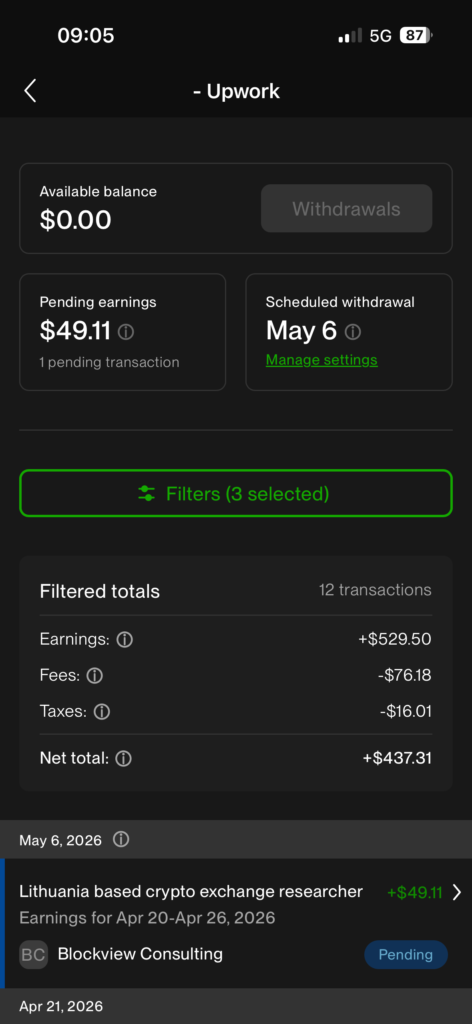
💰 Results: Around $400 earned in 6 months
⏱ Time invested: Still tracking
🔥 Worth it? Still testing
🛠 Platform used: Upwork
I also filmed the whole experiment — the proposals that went nowhere, and the kind of job that finally got me booked:
Enjoying this report?
One email per experiment. Full numbers, no fluff.
I’ve been messing around with Upwork for about half a year now.
At first, I honestly thought it would be pretty straightforward.
Not easy, exactly. But logical.
I have a lot of experience in 3D modeling. I’ve made plenty of models, I understand the workflow, and it’s one of those skills where I can actually say, “Yes, I know what I’m doing here.”
On top of that, I’m an electrical engineer.
So when I opened Upwork and saw job posts for 3D modeling, CAD work, product design, electrical tasks, technical drawings, and all kinds of similar work, I thought:
Maybe this could be a decent side hustle.
There were jobs everywhere.
But there was one small problem.
Everyone else saw those jobs too.
The Obvious Strategy Failed
My first strategy was probably what most people would do.
I applied to jobs that matched my strongest skills:
- 3D modeling
- CAD work
- product modeling
- electrical engineering tasks
- technical design jobs
On paper, that makes perfect sense.
If I know 3D modeling, I apply to 3D modeling jobs.
If I’m an electrical engineer, I apply to electrical engineering jobs.
Simple.
Except Upwork does not work only on logic.
It also works on reviews, profile history, proposal timing, price, client trust, and probably a little bit of luck sprinkled on top like bad seasoning.
And I had a problem there.
I was applying as one person in a very crowded room.
For many jobs, there were already tons of freelancers sending proposals. Some had years of Upwork history. Some had dozens or hundreds of reviews. Some were probably cheaper than me. Some were faster. Some simply looked safer to the client.
So even if I could do the work, I was just another proposal in the pile.
And that pile was big.
I applied to a lot of jobs.
Not five.
Not ten.
Not “I tried twice and gave up.”
Hundreds.
And how many jobs did I get accepted to?
Zero.
Actually zero.
Not a dramatic internet zero. A real one.
That Was Pretty Demotivating
At some point, Upwork started to feel like shouting into a giant empty hallway.
You spend time searching for jobs.
You read the description.
You write a proposal.
You try to sound professional but not robotic.
You send it.
Then nothing.
Again.
And again.
And again.
The annoying part was that I wasn’t applying to random jobs I had no business touching. I was applying to things that matched my actual experience.
That made it even more frustrating.
Because in my head, I kept thinking:
“Come on, I can do this work.”
But being able to do the work and getting chosen to do the work are two very different things.
That was probably the first real lesson from this experiment.
A skill is useful, yes.
But if the category is overcrowded, the skill alone may not be enough.
3D modeling has a lot of jobs, but it also has a lot of freelancers. Electrical engineering work exists too, but clients often choose people with strong profiles, reviews, platform history, or very specific past projects.
Fair enough, I guess.
Still painful.
The Question That Changed My Strategy
I was close to giving up on Upwork completely.
Not in a dramatic way. More like: “This is wasting my evenings, why am I doing this?”
Then I started thinking about it differently.
Instead of asking:
What jobs match my main skills?
I asked:
Where do I have an advantage that most freelancers do not?
That question helped much more.
Because my strongest advantage on Upwork was not actually 3D modeling.
It was not electrical engineering either.
It was location.
I live in Lithuania.
At first, I didn’t think that mattered much. Upwork is global, right? People hire from everywhere. Location seemed almost irrelevant.
But then I noticed some job posts where being from Lithuania was exactly the point.
Not complicated engineering jobs.
Not high-end 3D modeling.
Mostly simple local research tasks.
Things like checking Lithuanian websites, researching local companies, testing local platforms, comparing local services, or collecting information that someone outside the country would struggle to gather properly.
That was the opening.
Going Local Worked Better
So I changed my approach.
I stopped focusing on the big, global 3D modeling and engineering jobs.
Instead, I started looking for Lithuania-specific work.
And suddenly, things changed.
Not overnight in some magical “I made $10k this week” way. Nothing like that.
But I actually started getting accepted.
The jobs were usually not complicated. Most of them were local market research tasks. Basic research, checking websites, collecting information, testing platforms, looking at local services.
Not glamorous.
Nobody is going to make a motivational YouTube video about checking local market data for a few dollars.
But here is the important part:
I could actually get the jobs.
And after months of getting ignored, that felt like a win.
The competition was lower. My location mattered. My local knowledge mattered. And suddenly I was not competing against the entire planet.
I was competing in a much smaller pool.
That made all the difference.
My Results So Far
So far, I’ve made around:
$400 in half a year
That is not a lot.
Let’s be honest, nobody is retiring on $400 in six months.
But compared to where I started — hundreds of proposals and zero accepted jobs — it is progress. Real progress.
More importantly, I finally found a strategy that works better for me.
Instead of trying to win the most crowded categories, I found a smaller niche where I had a natural advantage.
That sounds obvious now.
It did not feel obvious when I was sending proposal after proposal into the void.
This Month Was Better
This month, I landed two more jobs.
The first one is a local betting sites research project.
It should last around 6 months and pays:
$40 per month
That is not huge money, obviously. But the work is simple, local, and recurring. I like recurring small jobs because they are predictable. A small predictable job is still better than a perfect imaginary job.
The second one is a local crypto market research project.
This one should last around 2–3 months.
The rate is:
$12 per hour
The work is capped at 5 hours per week.
So the maximum is around:
$60 per week
Again, not life-changing. But for simple research work, it is interesting.
Especially because this came after a period where I genuinely thought Upwork might just be useless for me.
What I Learned
The biggest lesson is that the obvious category is not always the best category.
I thought 3D modeling would be my strongest route because that is where I have real experience.
But on Upwork, experience is only one part of the game.
If a job has dozens of freelancers applying, and many of them already have strong Upwork profiles, reviews, and completed projects, then being capable is not enough. You also need to look like the safest choice.
As a beginner on the platform, that is hard.
Local jobs are different.
If a client needs someone from Lithuania, then most freelancers are automatically less relevant.
Not because they are bad.
Just because they are not local.
That gave me an advantage that had nothing to do with being the best freelancer in the world.
I was simply the right person for a specific local task.
Sometimes that is enough.
Why Local Jobs Worked Better
There are a few reasons this strategy worked better for me.
First, the competition is smaller.
A global 3D modeling job might attract a huge number of proposals. A Lithuania-specific research job has a much smaller group of suitable applicants.
Second, the work is easier to start with.
Most local market research tasks do not require advanced technical skill. They require attention, local understanding, and the ability to follow instructions.
Third, clients need real local context.
Some things are hard to research properly if you do not understand the country, language, websites, habits, or local market.
And fourth, these smaller jobs help build activity on the platform.
Even small projects matter when you are starting from nothing.
A completed job is better than a perfect proposal that never gets answered.
Is Upwork Worth It?
For me, the honest answer is:
Still testing.
If I only looked at the first part of the experiment, I would say Upwork was a complete waste of time.
Hundreds of applications.
Zero jobs.
A lot of frustration.
Not exactly inspiring.
But after changing the strategy, it started to look more useful.
I still would not call Upwork easy money. You need to search carefully, apply to the right jobs, communicate clearly, and actually do the work properly.
But I no longer think it is impossible.
I just think the strategy matters more than I expected.
For me, broad categories did not work.
Local niche jobs worked much better.
Would I Recommend This?
If you live in a smaller country, I think it is worth checking.
Instead of only applying to global jobs in your main skill area, search for jobs that mention your country, city, language, or local market.
For example:
- local market research
- website testing in your country
- app testing in your country
- local competitor research
- price checking on local websites
- collecting local business information
- reviewing local platforms
- country-specific research tasks
These jobs may not sound impressive.
But sometimes a boring job you can actually get is better than an impressive job where your proposal disappears under fifty others.
That is the part I had to learn the slow way.
My Current Verdict
My current rating for Upwork is:
KEEP TESTING
It is not a major income stream yet.
The first strategy failed completely.
It took months to find something that worked.
But now that I have started getting accepted for local jobs, I think the experiment is worth continuing.
The main lesson is simple:
Do not only compete where your skill fits.
Compete where you have an unfair advantage.
For me, that advantage was not just 3D modeling.
It was not just electrical engineering.
It was being local.
And on Upwork, that finally made the difference.
Not financial advice. This is just my personal side hustle experiment and real experience testing Upwork.
Update — September 2026
Half a year into the local-jobs approach, the account had earned about $700, and it has earned more since. Two contracts carried most of it: research on local bidding sites, roughly $40 a month, which ran for about six months, and local crypto market research at $12 an hour, capped at five hours a week.
How to find these jobs. Search for the words that describe the constraint rather than the skill: local, in-country, native, on the ground, market research, website testing, app testing, price checking. Read the job description for the line that says the client needs someone in a particular place, then say plainly in your first sentence that you are there.
What I would tell a beginner. Your first goal on Upwork is not a good job, it is a first review. Take the job nobody else is eligible for, do it properly, and then go back to bidding on the work you actually want with a profile that is no longer empty.
More side hustle experiments
- How much my 3D printing side hustle actually makes
- Do 3D model platforms actually pay you? Seven sites, what they gave me
- Is Respondent.io legit? I got paid $95 for one hour
- Do apps that pay you to walk actually pay? I tested 7 over 100,000 steps
I write up one side hustle with real numbers every week in Hustle Weekly — free, and no hype.